Your Guide to the Reality of Animal Circus


"The academic panel concluded that there appears to be little evidence to demonstrate that the welfare of animals kept in travelling circuses is any better or worse than that of animals kept in other captive environments" - Executive Summary of the DEFRA Circus Working Group 2007

Join us on Facebook The WELFARE of Circus animals.

Friday, 10 August 2012

Britain's got Talented Liars

circus
circus (Photo credit: fsse8info)
Our country is known worldwide for its love of animals.  In fact, we can be proud of the fact that the world’s first animal welfare charity, the Society for the Prevention of Cruelty to Animals, which later on became the RSPCA, was established in this country in 1824.  The love and respect for animals and their needs is a quintessential part of our culture and is reflected both in our animal welfare legislation and in the way people interact with animals on a daily basis.

I have been working with dogs for years, and still people take me by surprise with their extreme kindness towards their pets.  I have several elderly customers, not in the best of health, who take their equally elderly dogs out on strollers so they can enjoy a nice walk without overexerting themselves.  I know plenty of ladies who perm and dye their own hair at home but fork out every month for their dogs to have “a proper groom”, because they “deserve it”.  In fact, I’m willing to bet that a good proportion of my doggy customers eat better than their owners, and definitely better than me.  Let’s face it; most of us are animal-mad here.  We treat our animals well, and expect other people to maintain the same high standards with their animals.


Monday, 6 August 2012

Going for Gold but not in Kilmarnock.


Just when you thought that things could not get any worse for circuses in the United Kingdom we now have the famous Zippos Circus announcing that it will be its last time performing on council land in Kilmarnock, Scotland. This is due to the fact that East Ayrshire Council has decided to ban all circuses with animals from its land

Friday, 22 June 2012

Britain's Got Talent, and Strange Bedfellows Too

In recent decades the Circus community has been plagued by false accusations of animal abuse and mistreatment.  Animal Rights organisations such as PETA, CAPS and Born Free, as well as allegedly more moderate Animal Welfare organisations such as the RSPCA have ganged up to vilify a whole industry and community.  At the bottom of these brutal campaigns is the claim that “travelling circuses, by their very nature, cannot meet the welfare needs of wild animals”.

This is despite the fact that the only independent scientific study of Animal Welfare in Circus, carried out by Dr Marthe Kiley-Worthington and commissioned by the RSPCA and UFAW (Universities Federation for Animal Welfare) demonstrated that “circuses do not by their nature cause suffering and distress in animals”.


The fact is that while thousands of people are taken to court by the RSPCA every year, no British Circus has ever been convicted of animal cruelty.


The campaigns conveniently ignore both the facts and the studies, and continue their harassment of animal circuses and their public.  Animal circuses are routinely subjected to verbal abuse, death threats, vandalism and theft.  The animals themselves are often subjected to cruel stunts by activists seeking to disrupt the shows – activists letting off fireworks near circus horses now happens so regularly as to be almost routine.

Wednesday, 20 June 2012

More Voices from the Sidelines...

"circus"
"circus" (Photo credit: thaiz_mm)
This month Rouster praises two journalists for having the courage to take a look at the "pro" side of the animal circus debate. It would appear that June is not the month to be advocating that side from a media point of view. One year ago back bench politicians voted in favour of a ban on the use of wild animals in UK circuses. I won't go into details about the unfairness of this particular "debate". You have only to consult our list of articles and essays on the right hand side of this blog to see what happened in a so-called democratic country. This is also the month that saw the beginning of Animal Defenders International's ludicrous case against Bobby and Moira Roberts.

Saturday, 26 May 2012

How Long Will Britain’s Have Talent?


The final of the television talent show “Britain’s Got Talent” announced its winner “via popular public vote” and it was the human-animal duo of Ashleigh and Pudsey the dog who won.  Thus demonstrating very clearly that, despite the claims of the highly vocal animal-rights groups, the British public still has a clear affection for performing animal acts. Although the most disturbing thing about this is that if Ashleigh and Pudsey’s performance had taken place within the context of a circus it is possible that the reaction would not have been as supportive.

Friday, 11 May 2012

The Hitman and Fur

There was a time when informing a largely ignorant general public that animal rights activists regularly occupy the top spot of FBI's "Most Wanted" domestic terrorists prompted shock. It was a good card that Rouster liked to play when they wanted to cut to the chase in explaining the dangers posed by those who believe in a policy where all animal usage by humans - from hunting to research to manufacturing to pet ownership - is criminal exploitation. However, this fact, which stirred up anti-animal rights groups in the 1990s, but didn't really impact on the general public, had almost become something of a joke in the eyes of some media commentators. "Balanced" documentaries began to emerge in the 2000s that implied the FBI's decision to place animal rights activists in the same league as white supremacist action groups was something of an over-reaction. After all the FBI have not been above such over-reactions and many would argue outright distractions. In the 1930s FBI founder J.E. Hoover's decision to list bank robbers like John Dillinger and Ma Barker as "public enemy number ones" whilst publicly denying the existence of the rapidly rising American Mafia.

There have been incidents, where "harmless" activists or supporters seem to have been hounded by the feds and unfairly treated. This, of course, is wonderful material for those animal rightists who lean heavily on sexy anti-establishment politics. However, one needs to take a step back and look at the whole animal rights picture to get a better idea of what we are dealing with. Are these concerns legit?

Wednesday, 2 May 2012

Elephant Hind Leg Myth - Debunked!

The tide of collective human emotion is a strange and unpredictable thing. It sweeps one way, seemingly bringing joy and wonderment for many years and then, suddenly, it sweeps another way inspiring pity and pathos - sometimes, all around a single issue. Some people think in pictures and this is an image that can illicit the most polarized of views one can imagine. For as long as there have been performing elephants, the "trick" or behaviour of having these huge land mammals stand on their hind legs has been a regular mainstay of most routines. It is an impressive sight; a huge hulking animal exhibiting amazing balancing ability. Animal trainers have further extended this skill by having their charges perform other balancing skills, standing on various objects and even on one leg. Audiences were and still are awed by these feats. However, over time, the very concept of having an elephant stand on its hind legs has also become a regular feature of animal rights propaganda.  Unfortunately there is strong evidence that the idea that an elephant standing on its hind legs is an unnatural and damaging action has permeated some of our media.

Friday, 30 March 2012

The "ethical question"

The Journal of EthicsThe Journal of Ethics (Photo credit: Wikipedia)To put it mildly, the "ethical question" about animals in Circus scares the life out of me.  Let me put you in the picture, just in case you missed the story unfolding:


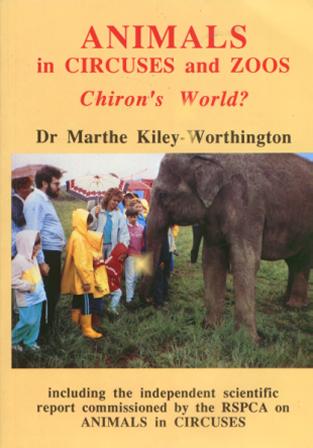
1990. Dr Marthe Kiley-Worthington, one of the worlds foremost animal behaviour experts, publishes a book titled “Animals in Circuses and Zoos: Chiron’s world?” .  “Chiron was a centaur, half man half horse, symbolising the joining together of humans and animals. Is this close relationship what is happening, or what could happen, between people and animals in circuses and zoos?”  The book contains the results of an 18-month scientific study of circus animals, in comparison with animals in zoos and in the wild, commissioned by the RSPCA and UFAW (Universities Federation for Animal Welfare).  The summary of the results is as follows:

“After 3000 hours of scientific observation of animals and many visits to circuses and zoos, including training, travel and performance, Dr Kiley-Worthington concludes that, while there are improvements that must be made, circuses do not by their nature cause suffering and distress in animals. She states, "On balance, I do not think that the animals best interests are necessarily served by money and activities diverted to try and ban circuses and zoos either locally or nationally. What is much more important is to continue to encourage the zoos and circuses to improve their animal welfare along the lines recommended."”

Friday, 23 March 2012

The House Divided & Sanity from the Sidelines

circuscircus (Photo credit: fsse8info)Rouster does not wish to waste our reader's precious time drawing more attention to a certain individual who has used the unfortunate predicament animal circuses in the UK currently face to bolster their own business. It saddens (although doesn't surprise) Rouster to see said individual, who freely admits to having made his name and fortune through animal circuses, now being championed by the likes of CAPS and the animal rights movement in general as they fight
their "cause".